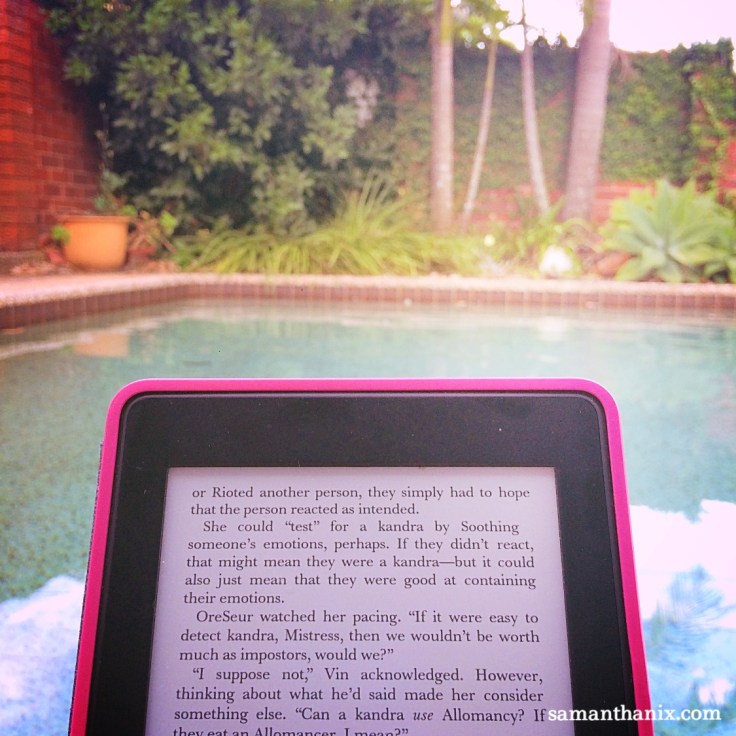
Summer is officially over. There, I said it. Some part of me is devastated by this sentence, but the pale winter-baby half of me is secretly relieved. The second half of Sydney’s climate-change-induced summer this year brought a combination of days so boiling hot that I couldn’t be bothered to do anything other than lie around on the grass reading, and days that were suddenly and inexplicably cool, so much so that all I want to do is snuggle up on the couch and read. How convenient that was, considering I’d set myself a goal to read more this year. If you’d like to peruse Part I of Summer Reads In Review, click here. As for part two…
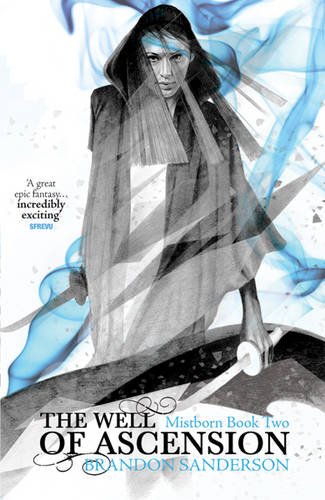
1. Mistborn Trilogy: Book 2, The Well of Ascension by Brandon Sanderson
I really, really enjoy these books. I love the characters, and I love the world that has been created. I’ve always been a softie for a big cast, which is something I’ve been told you can only just get away with in a fantasy saga like this one, and isn’t suitable for other kinds of books. I’m not convinced. Maybe that’s because it doesn’t take much for me to empathise with a character. Or maybe it’s because I’ve read so many trilogies and series’ that I feel like I’ve been able to get to know characters quite quickly. Regardless, I don’t just love the main characters in this book, I love the supporting cast, and I love that I get to hear their points of view a little more in this second novel. The thing I really don’t enjoy about this series is the tedious introduction, at the beginning of each chapter, where a prophecy or journal of is recited. It could be clever, and I understand why it is happening, as these snippets become highly relevant. But it comes across as repetitive and boring, or just plain old confusing, at best.
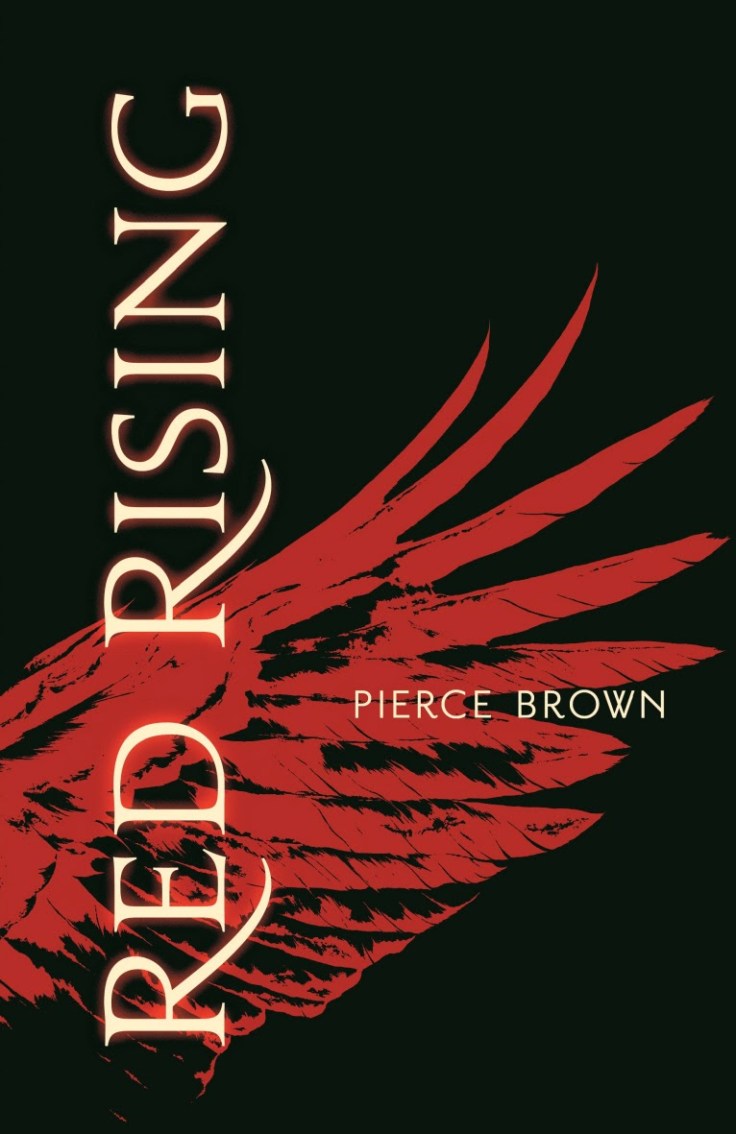
2. Red Rising by Pierce Brown
If you have any interest in dystopian science fiction, read this book. This is the adult version of Hunger Games, but with more world-building. My partner recommended this one to me. After seeing that he couldn’t put it down, I was actually a little disappointed when I started. The beginning read a lot like Wool, and I wasn’t really keen for another world like that. But the beginning is the world the main character leaves behind, and as soon as he does, you don’t have time to breathe, just as he doesn’t. It’s too epic. This book offers a very creepy glance in to a future where everything that sucks about humanity has basically taken over. It holds you right on the edge of despair and hope, and through clever plot-building, foreshadowing, and withholding key information, lets you feel like you’re right in the middle of every battle. I’m itching to get the next two books and gobble them whole.

3. The Storyteller by Jodi Picoult
As you might have guessed from the majority of books that I review, Jodi Picoult’s novels aren’t my usual genre. A friend, who promptly passed on her copy, recommended this to me. In the end, I’m so glad for it. The Storyteller follows Sage, a baker who is dealing with her own inner demons while befriending an elderly man with demons of his own. It explores the Holocaust and Nazi Europe, while making us question what forgiveness really means, and whose place it is to forgive another, or yourself. I thought that after all of my fast-paced, dystopian, sci-fi and fantasy, I’d find this a little slow. It isn’t. Partly because Jodi Picoult uses her characteristic changes in viewpoint to keep you interested, and partly because the way she crafts both the historical world of a Jewish life during WWII, and a fantasy world of vampires and demons, (re)creates exactly the kind of world I’ve always been interested in. I’d highly recommend this novel to a wide variety of readers. Sometimes, appealing to the masses is kind of impressive.
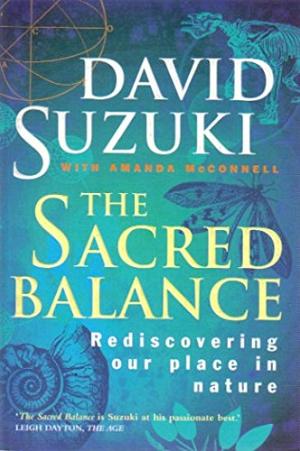
4. The Sacred Balance: rediscovering our place in nature by David Suzuki
I’m in love with this book, which is probably obvious if you’ve read any of my other blog posts. It’s a treaty to take care of the environment and therefore ourselves; a piece of science writing that is thoughtful and beautiful, and engages me in statistics by connecting them inextricably with individual and community experiences, and a sense of place. It’s a beautiful, simultaneously tragic and hopeful look at what we need to do to protect our environment and our own sense of self and wellbeing. Suzuki understands that people are creatures of Earth, and we depend on the air, water, earth, and fire that it provides, a concept I’ve tried to bring to life in my Children of the Solstice manuscript. He also understands that our connections with the people and places around us are what ground us, spiritually. Even at seventeen, writing an essay for my HSC, I understood the importance of this, writing in a slightly clunky thesis, “The texts [including The Sacred Balance] studied challenge their globalized context of economic and scientific domination that does not provide the individual with the means to sustain vitality and thrive philosophically and spiritually, which would result in necessary self-realisation.” If the world’s politicians placed as much value on creating an ecologically sustainable, satisfying and fair future for all of humanity, as David Suzuki does, I know we would all be far happier, and in far better circumstances.
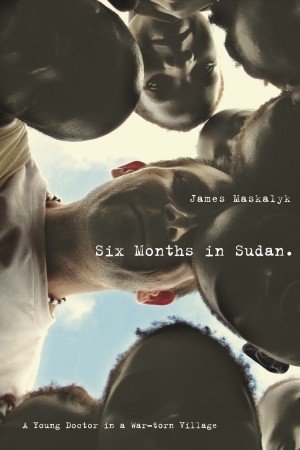
5. Six Months in Sudan by James Masalyk
This novel follows a young doctor, James Maskalyk, working with Médecins Sans Frontières in a border village called Abyei, right between the north and south of Sudan. It’s autobiographical, and based on a blog he composed while over there in 2007. I met James very briefly at the Sydney Writers’ Festival several years ago, and as part of the inscription on the book he signed, he wrote “I hope this brings you closer to Sudan, and through that, the truth”. It chronicles the story of the volunteers and workers who leave their homes behind to take care of others, many of whom are suffering, and in such harsh circumstances that it’s often difficult to see much of the positive effects of what they’re doing. It’s a thankless job, in a war-torn village where the people are resilient and strong, even in the face of constant displacement and daily battles to survive. While this book doesn’t skim over the existential crises one might face in circumstances where people are needlessly dying every day, it delivers the harsh reality with enough sense of hope and purpose so as to allow you to emotionally connect. Mostly, the writing is realistic and somehow, also poetic. Sometimes it’s a little stilted and jolting, but it seems to match the experience of a young man who doesn’t have the same kinds of emotional connections in his ‘everyday life’ as I’m used to, and is also having to compartmentalise everything just to continue to be effective in his job. As I mention in another blog post here, this books really made me appreciate the life I live, but also helped to remind me that just because I don’t see suffering around me on a daily basis, that doesn’t mean it isn’t happening.
 Samantha Todd