
This is me at Yosemite last year, in awe of a giant fallen sequoia that was wide enough to walk through. I quit science at the end of Year 10. I wish I hadn’t. But I was too squeamish for biology, not mathematically minded enough for chemistry and physics, and too excited by the possibility of having a whole timetable full of just English and history. I wish that the arts and sciences weren’t so readily accepted as polar opposites, both by society at large, and by my seventeen-year-old self. Then, perhaps, I would have studied the whole lot.
In saying that, I don’t have infinite hours in the day, and I don’t think I would have been very good at any of my school subjects if I’d been gifted a time-turner to study them all. Hermione did a stellar job, and I love learning just as much as she does, but I fear that if we don’t all pick a few things to focus on, then we become generalists in all things, and knowers of nothing.
(Tangent alert…Wouldn’t it be great to be able to study everything, though? I know that’s got to be the nerdiest thing to think and say, but I’m serious. Imagine knowing everything. Imagine having an in-depth understanding of all topics, and being able to hold your own in a debate about all manner of sciency-artsy-geeky-historical-political-social-cultural things? I’m getting stomach cramps from the excitement of the idea. Maybe I should write a book about it. Or a fan-fiction, where I hone in on Hermione and her time-turning adventures through study. Just jokes, no thank you. But did I mention that fan-fiction is also something I studied at a university? Learning rules.)
My limited knowledge of science has therefore come from clever scientist friends, the Facebook group IFLScience, David Attenborough voiced documentaries, and the written word. The most recent of my scientific endeavours have been undertaken sometimes for pleasure, but mostly for work-related pursuits. For instance, I’ve been reading a lot more about anatomy and exercise science, in an attempt to improve my aerial silks instructor knowledge. I’ve also frantically Googled ‘house plant care’, in an effort to stop murdering my plants through over-watering i.e. over-loving, because horticulture is a little bit more about science than just being really keen to have aesthetically pleasing and soul satisfying living organisms scattered around your home.
Mainly, my recent science-based endeavours have been based on researching my novel. I’ve mentioned this briefly here and here, but in case you missed it, I’ve been re-reading David Suzuki’s The Sacred Balance as world-building research and inspiration, and I’m absolutely engrossed by it. This is why, when Issue 231 of Newswrite (NSWWC) mentioned that it included an article by Peter Doherty on “the art and practice of science writing”, I got a little bit excited, where previously, maybe, I would have just glossed over it and looked for something more aligned with my creative interests.
Unlike me, Peter Doherty did choose to focus his life’s work on science, and as well as being a Nobel Prize winner and dedicated scientist, he is the author of the science demystifying endeavour that is The Knowledge Wars, amongst many other clever texts. In his article, he advocates for not just scientific research papers, but for publicly accessible (intellectually as well as physically accessible) good science writing. The kind of writing that requires “people to engage more broadly with the idea that verifiable reality is what really matters”, Doherty explains. Essentially, he’s saying that it is extremely important that the general public – those of us that, though we may not feel like it, have an influence on the sort of agendas our politicians decide to pursue – is exposed to a wide range of scientific writing. He is emphasising that this writing is based on facts alone. It’s not politically motivated, or a publicity stunt. Believing in and acting on well researched, scientific fact is important to Peter Doherty, and to me, and it should be important to you, too, no matter what Trump spews out about alternative facts. Maybe now more than ever, scientific fact reaching and saturating the general public is vital. Climatologist Professor Michael Mann certainly thinks so, going so far as to suggest that ignorant, self-centred views perpetuated by men like Trump could be cataclysmic. Trump could, actually, destroy the world.
Being a well-informed scientist who also knows how to write an interesting story is, fortunately, maybe not the only way to bring scientific endeavours to the forefront of society’s concerns. Both Peter Doherty and Michael Mann emphasise that serious scientists rarely write books and campaign about scientific truth – they’re often too busy being involved in the research and pursuit of science itself to spread the knowledge to everyone else. Thankfully, writers like Bill Bryson, who, in Doherty’s words, “aren’t science trained but make the effort to talk to real scientists and listen to what they say”, write popular science books than can help to better inform the rest of us, without putting us to sleep. Even most dystopian novel writing or television programming draws on at least a little bit of the science around, say, climate change. And Doherty suggests that “Whether we engage readers via well-constructed and interesting accounts, through stories about real or imagined people and events, or via humour – Tim Minchin comes to mind – it doesn’t really matter”. The point is to be sure that we are getting across the idea that as humans, we have a duty of care to all life on earth. This is what I hope to explore in Children of the Solstice, where I have created a race of human-type-beings whose purpose is to protect the planet.
Understanding science is integral to our human ability to thrive, rather than just survive, and to help our planet and all its living things to do the same. “How do we convince people that, ultimately, we are a construct of nature, not the other way round?” Doherty asks. Science writing, or at least, writing informed by and concerned with science and the future of our planet, is important in achieving this. My understanding of science is very minimal. But for the love of the planet, I am more than willing to accept the views of renowned scientists, Nobel Peace Prize winners, and other people who know a great deal more about this than I do. We need to listen to these people.
Whatever the avenue, if you’re focusing on reading or writing about something that changes the way people think about our world and our delicate place within it, you’re doing something worthwhile. In a personal effort to learn as much as I can about science, while still fulfilling my general goals of reading as widely as possible, here are some texts to kickstart your scientific curiosity:

1. The Knowledge Wars by Peter Doherty: this is a great starting place, as the purpose of this book is to provide readers with a knowledge base to analyse and evaluate science writing, research and debate, and make informed decisions that lead to meaningful action.
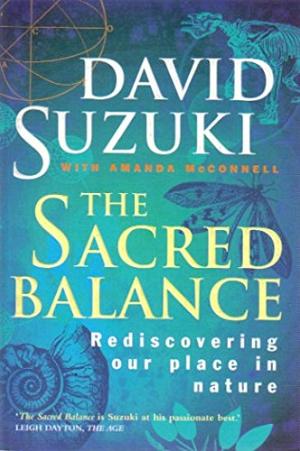
2. The Sacred Balance by David Suzuki: this book is a beautiful and hopeful (while still alarming) guide as to how to reconnect spiritually and philosophically with a world that has been forever changed by globalisation and industrialisation. It’s a reminder to take care of our planet and ourselves, and that our resources are finite and intrinsically linked with our way of life. If it weren’t for the earth, sun, air and water, we wouldn’t be alive. The fact that it is still so relevant – perhaps even more so – a decade after its initial publication date, is proof that we need to listen earnestly to scientists and take on their advice.
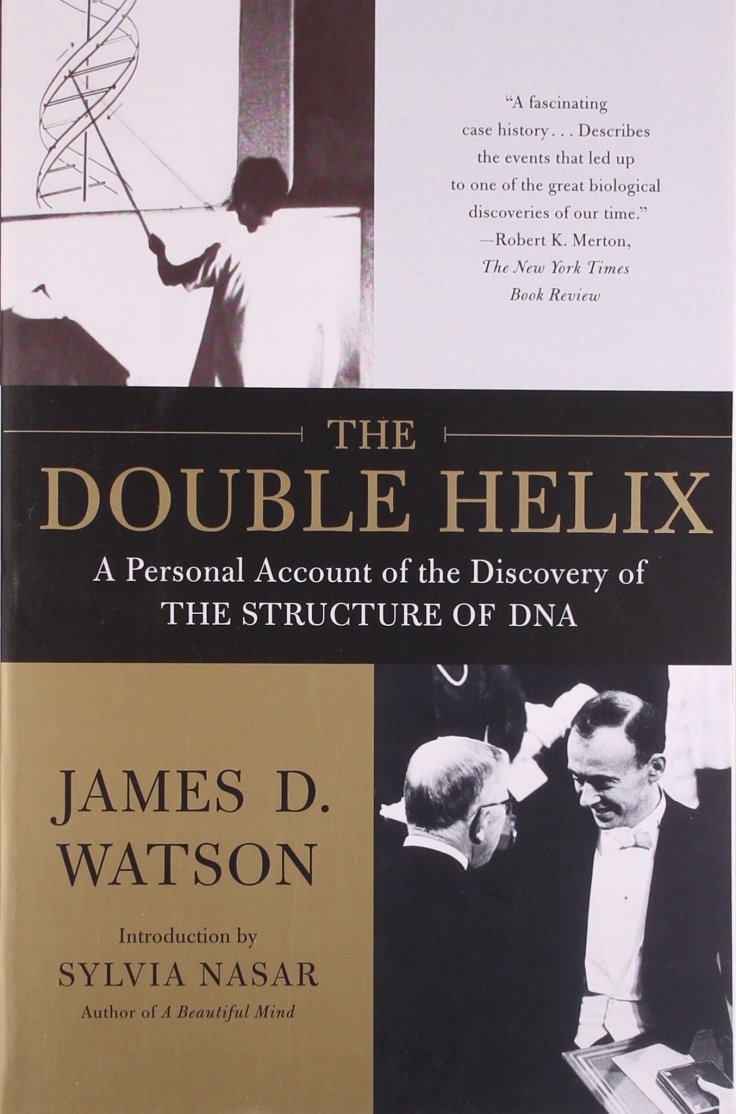
3. The Double Helix by James Watson: I’m trusting Peter Doherty’s advice here as he suggests that this book is “a must read for every young student of science”. However, I’m also going to take into account Tim Radford’s review of the book, which suggests that while the writing is “startlingly good” and that James Watson’s part in the discovery of DNA is profound, he’s also a bit of a nasty, know-it-all. From the descriptions I’ve read, I can’t imagine I would have liked the man very much.
4. 1992 World Scientists’ Warning to Humanity: this isn’t a novel, and it won’t take you long to read, so follow the link now, and feel that same sense of bewilderment that I did, when I discovered that this warning issued by some of the world’s most intelligent women and men was basically ignored, and still is. Approximately 1,700 of the world’s leading scientists, including the majority of Nobel laureates in the sciences, issued this appeal in 1992. It begins,
Human beings and the natural world are on a collision course. Human activities inflict harsh and often irreversible damage on the environment and on critical resources. If not checked, many of our current practices put at serious risk the future that we wish for human society and the plant and animal kingdoms, and may so alter the living world that it will be unable to sustain life in the manner that we know. Fundamental changes are urgent if we are to avoid the collision our present course will bring about.
It terrifies me that this isn’t public knowledge, and that people still don’t accept climate change as fact.

5. The Demon in the Freezer by Richard Preston: my partner is reading this book at the moment, which means that just as I’m about to drift of to sleep, I’m beguiled by charming stories of boils that eventually take over your entire body, eyes turning black from blood underneath the skin, and uncontainable biochemical weapons that could kill the world a trillion times over being launched into the sea by Russia. This book follows smallpox and anthrax through history, reminding us that biological warfare is a terrifying threat under which we all live, and that maybe we really should be concerned when people like Trump are in charge of America (okay it doesn’t say that, but it definitely makes me terrified to sleep at night).
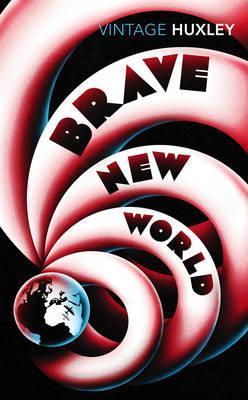
6. Brave New World by Aldous Huxley: Huxley published this dystopian novel in 1932, and alongside many other Australian school students, I studied it in high school. Even then, I found it eerily prophetic, in the same way as 1984 or Frankenstein hits the mark on a range of scientific ‘progresses’ gone horribly wrong. Peter Doherty states that books like this, and the one above, generally work better to interest the public than books that focus purely on “reality, information and with no personalised shock-horror theme”. While it isn’t a scientific research paper, Huxley’s novel is engaging writing that makes you seriously reconsider the lengths that we will go to in the pursuit of scientific progress and the ideal society, removed from any identifiable connection with nature and reality through genetic engineering, consumeristic brainwashing and infantilisation. I could fill this entire list with sci-fi novels, so for an excellent place to start, see here.
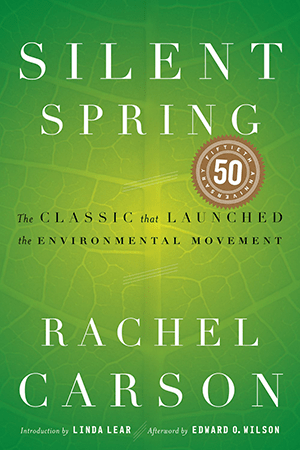
7. Silent Spring by Rachel Carson: this has been recommended to me countless times, as a book that inspired the modern environmental movement. Carson was a renowned scientist who dedicated much of her professional life to documenting and analysing the misuse of chemical pesticides on a large scale. She focusses on the need for humanity to act responsibly and carefully, because we only know a tiny part of our universe – we don’t have sufficient understanding of the intricate and minute workings of our biodiverse world. Certainly not enough to allow scientific ‘progress’ (or short-term economic, capitalist gain) to dictate what we do and don’t put into our earth’s atmosphere, into our bodies, and into the bodies of all living things.
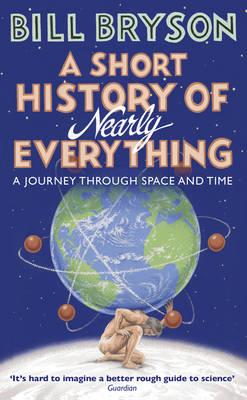
8. A Short History of Nearly Everything by Bill Bryson: Bill Bryson shares my sentiment that science is enormously important, despite the fact that he was a terrible science student in school, as was I. As I mentioned above, Bryson deeply cares about being informed – and entertaining and informing the general populous – about scientific endeavour, by engaging with scientists and listening to what they have to say. This is a great place to start if, like me, you’re not actually sure that you’re interested in reading about science (even when you believe in it and know that it’s extremely important). The word ‘history’, and the suggestion that Bryson knows how to make a meaningful narrative out of facts, is what lured me to this book; stories are the way we make sense of the world, so it’s important that our stories contain as much science as possible. Watch a quick video where Bryson chats science writing here.

9. Lab Girl by Hope Jahren: this is, in Doherty’s words again, “a great example of how telling a very personal story draws us in to appreciating the underlying science”. Jahren is a geobiologist whose 2016 novel explores what we can achieve when we bring love and compassion, and science and exploration, into the same space. She offers a part memoir, and part treaty to take care of our trees, our plants, our flowers, and our soil, in an effort to maintain a meaningful relationship with our world. She also writes a pretty neat blog here.
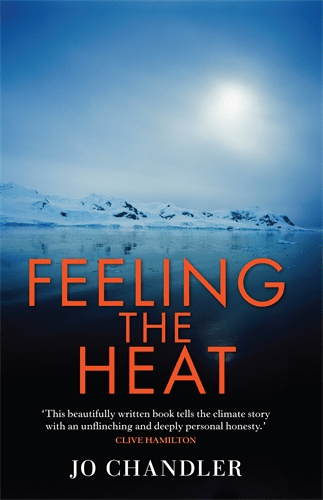
10. Feeling the Heat by Jo Chandler: Jo Chandler is a journalist who has been travelling and writing about climate change and our environment for the past decade or so. This book chronicles Chandler’s exploration of Antarctica, Papua New Guinea, Australia and other landscapes “in the company of scientists trying to decode climate information that will be critical to the decisions we make for the future of the planet”, according to Melbourne University Press. Chandler also helped to edit a guide to some of the Best Australian Science Writing 2016, which provides an even more extensive list of books that we should all take a look at. Excuse me while I finish typing and spend some time agonising over where exactly I’m going to start in my endeavour to read all things science.
 Samantha Todd