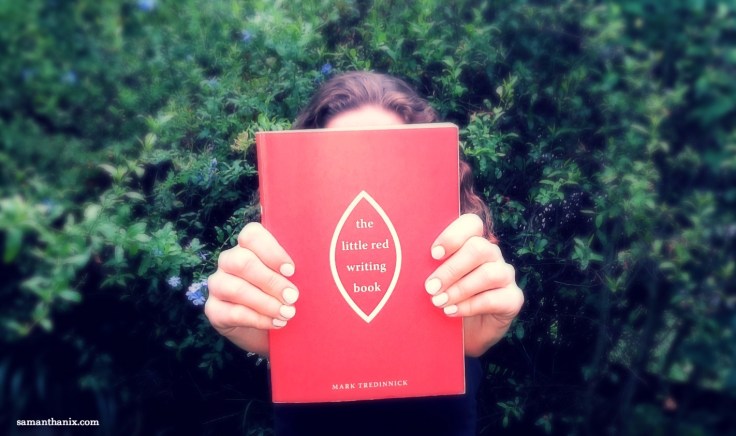
I wanted to write a post that summarised five or six or seven of the books and websites I most frequently turn to when I need advice on writing. Instead, I got stuck on the first one on my list; The Little Red Writing Book, by Mark Tredinnick. This is probably because I’ve never been very good at short writing – I tend to write too much, and have too much to say, and it won’t all fit neatly in one blog post. I often finish halfway through my thoughts and leave the rest unsaid. Funny that I say that now, when one of Tredinnick’s most important pieces of advice is to keep one’s writing clear and short. But he also advises that writing is simply talking on the page, and the way that I talk is a little bit long and everywhere. I don’t mind that – I think some of my best thoughts come from everywhere-and-nowhere speak. But in an effort to reflect on what I think is most important to me, as a writer, whether that be a writer of this blog, or a writer of novels, I’ve decided to dedicate a whole post to the advice of The Little Red Writing Book, which is both the prettiest and ugliest ‘what is writing and how do you do it?’ book that I own.
The Little Red Writing Book is one of the earliest books on writing I received, when I told my parents that I wanted to pursue creative writing seriously, and it is still one of the most beautifully written, and useful books that I own. It gives practical, honest, and poignant advice on writing and states its intention to “encourage richer and smarter writing” and “do something about bad language and its consequences”. I often return to it when my writing feels stagnant and forced. It emphasises that “writing that’s any good sounds like someone talking well”, whether that writing is a note to a loved one, a novel, or a business proposal. It gives advice on grammar and punctuation, referring to Strunk and White several times, as well as many other masters of the craft, ranging from Aristotle, to Ursula Le Guin and Barry Lopez. It talks about taking care in your writing, and being aware of your writing, yet not self-conscious. It’s the sort of book that allows you to open any page at random and find the perfect quote on writing. Everything about this book is beautiful. Every sentence is carefully crafted. It tells a story and takes you with it. It takes its own advice.
That is exactly why it is my ugliest book. It is everything that I aspire to do in my own writing, and every time I pick it up, I re-read almost the whole book. The spine is crinkled and broken, and every page is covered in miscellaneous coffee-coloured stains of wear and tear and time, even though I don’t drink coffee. It smells old, though it was published only ten years ago. It’s a book that has adventured, and been wedged under all sorts of contraptions to hold it open at just the right page. I love it like my dog loves the teddy I gave her when she was a puppy; the teddy that used to have a bowtie and soft fur, and now has no eyes and one ear, and smells like it’s been carried around the garden in the rain. It’s so well-loved that I sometimes treat it not very well. It’s my parent book, or maybe my grandparent book, because it gives the best and wisest advice and yet I’m not quite ready to take all of its advice.
Here’s a taste of said advice, from my much-loved, prettiest, ugliest writing book:
-
“The best writing is clear, short and alive,” Tredinnick states. He emphasises that every word is important, and should be valued, because someone out there has taken the time to listen to these words, and because “Democracy – not just art – depends on the lucid expression of careful and independent thinking.” This is simple, thoughtful and profoundly relevant advice.
-
Sentence writing is a craft. You must learn it and practice it. You must put in mountains’ worth of effort to make a sentence effortless. “Work hard to make your writing seem to have cost you no effort at all,” Tredinnick says. He gives advice on how to do this, which ranges from making sure to properly locate your modifying clauses, to making sure that your sentences read like well-crafted music. Like any good teacher, he gives examples of sentences that are written well, as well as sentences that are awkward and piecemeal, for a variety of reasons. He also allows plenty of space for you to complete small exercises to help ingrain his lessons in your mind.
-
Read your writing out loud. This is advice I have been given many times, and advice that I give my students almost weekly. It is also advice that is rarely followed. But it is so simple, and always improves your work (this very sentence was changed four times because I read it aloud and realised it would sound better if I changed it). If you can’t be bothered to read your writing aloud to yourself before printing it, then why should a reader bother with it at all?
-
Write as though you are talking. This will make your writing clear, particularly when you are caught up in “trying to write like a writer”, which usually creates anxious and stilted prose. If you’re stuck, do anything else but write, or try and make a list of the reasons you are scared to write, so that your fears might be dealt with.
-
Rules are made to be broken. Okay, so he doesn’t actually say this, but he makes a few points about not clinging foolhardily to things that you might have been taught at school. For instance, I know plenty of English teachers who teach their students to use adverbs every time they write dialogue, when all the best writing advice demands that you use adverbs more liberally than wasabi. Students are also taught never to use ‘I’ in academic writing, which can sometimes end up with stuffy, poorly crafted sentences. “Don’t hunt for fancy words and erudite turns of phrase. Aim, instead, to speak, on the page, more carefully than you speak when you talk. But use the same kinds of words,” says Tredinnick.
-
Short words are best. He insists that everyday phrases and words are better than technical jargon. It’s much more impressive to see someone write simply about something complex, than vice versa. He says, “Good writing must be everything that fearful, political writing is not – it must be humane, plain, active, informal, concrete, clear and specific. It must have a voice. It must have life.”
-
No-one has ever sounded all that clever from trying very hard to sound clever. Tredinnick offers up lists of common mistakes one imght make in trying to sound clever, then suggests ways to correct them. For instance, don’t write amongst, write among. They mean the same thing. The same goes for utilize and utilization. There’s nothing wrong with ‘use’.
There’s so much more advice that Tredinnick provides, and I’d consider it worthwhile to transcribe every word of his book onto the page and into this blog post. But it would be a gross violation of copyright and entirely unnecessary, seeing as how you can buy his book yourself. I highly recommend that you do.
I should also say that I haven’t taken all of his advice. Maybe this is because I’m lazy and impatient, and I have conflicting goals, including but not limited to, writing beautiful sentences, having dinner before 9pm, becoming the best writer I can be, getting my novel finished instead of obsessing over every sentence I write in this blog post, launching an author website, and some day being able to put food on the table with money made from the thing I enjoy most: writing.
I think my reluctance to take all of Tredinnick’s advice is also because I’m prone to perfectionism, and I worry that if I try and take on everything, I’ll never write anything at all. Tredinnick is very good at what he does. But I’m just beginning, and I hope he would find it acceptable that I take on a piece or two of advice at a time. I think it’s okay to start somewhere, and The Little Red Writing Book is a very good place to begin.
Speaking of beginnings, I’ll leave you with an ending taken straight from this beautiful, ugly little book. It’s a piece of advice at odds with many of the things I’ve told myself about the intentionally relaxed process of blogging, but I think it’s important advice when it comes to writing novels, and writing at your very best, and making each draft better than the next. It epitomises what I aspire to be – my prettiest writing self – even as it emphasises the ugly bits of my writing as I continue to learn and grow. Tredinnick concludes,
Most of us don’t work quite hard enough at making elegant, clean, strange and lovely prose because it’s plain hard work. Hard to begin, and harder to sustain… In these times, more than ever, we need a little depth and care, generosity and poise. We need a little perspective and honesty and restraint.
I love a beautifully written sentence, and I encourage you to take Mark Tredinnick’s advice and create beautiful sentences and artworks of your own. I encourage you to read his book because he tells you everything he has learnt about writing, and because every sentence in it is useful and inspiring.
In saying that, I write this while at a stage in my writing journey that calls for concentrating on plot (“Let plots take care of themselves”, Tredinnick says), and letting myself make mistakes and write (and even publish, albeit online) in an imperfect way.
On reflection, I think that, perhaps hypocritical decision, is an okay one to make. I think that, for now, I’m happy to rebel against some of Tredinnick’s excellent and hopeful advice. Because perfect sentences are very important, but I grew up reading plenty of books that inspired me to imagine and read more and write more, and be a better me, even in their inelegant imperfection. And, if you’re at least aware of this, and you have the ability to critically reflect on yourself, your writing and your reading, even when you’re not writing beautiful sentences, then I think that’s okay, too.
 Samantha Todd